The shipwrecked ale that could change the way we drink – and eat!
By: JimOldfield
June 24th, 2012
No-one would have thought that bottles of ale – discovered by divers in a 170-year-old ship, wrecked off the coast of Finland – would be more than small beer…
But these toppled tipples are among the oldest beer in the world – and they could have huge implications in determining the future taste, health properties and safety of an entire range of food and drink!
For scientists found, buried in the ancient ales, four different strains of lactic acid bacteria – which could change the way the brewing and food industries work.
Researchers have found that the germs had “interesting potential applications” – arising from their high tolerance to age and stress, which make them possibly invaluable in the preservation business.
The wreck that began it all dates back to the 1840s, and was found off the Finnish archipelago.
On board it were five bottles of ale.
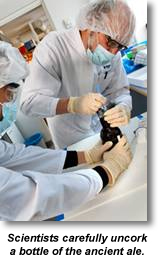 Finland’s VVT Technical Research Centre was given a grant by the government of Aaland to investigate the beer –which they have been doing for more than two years.
So far they have found no trace of living yeast – but discovered the DNA of what appeared to be dead brewers’ years and also a Dekkera yeast, such as was used in Belgian beers.
Now they are in the process of “reverse-engineering” the beer – which could isolate important microbes and also tell us what the ancient ale tasted like!
”What we want to do first of all is to analyse the contents of the bottles. After that, we hope to be able to recreate the original recipe so that it can be used to make beer”, says Rainer Juslin, Department Head at the Provincial Government of Åland.
The researchers found the bottles contained beautiful pale golden liquids, identified as beer by the presence of malt sugars, aromatic compounds and hops typical of the beverage.
v Chemical analyses showed that the beer could originally have featured hints of rose, almond and cloves.
The pale golden colour indicates that the beers were made from unroasted malt.
The burned flavour suggests that heating at the mashing stage was not under control, though it is possible that a smoky flavour in beer was appreciated at the time.
The beers were probably made from grain – barley or wheat or a combination of the two. Hops, of a variety typical of a couple of centuries ago, had been added before boiling the wort.
The wreck on which they were found appears to have been a 60ft Nordic sailing, boat built of spruce and pine.
Why she sank has not been established but it appears that she had been renovated shortly before being lost, in the 1840s.
Apart from the beer, she was also carrying champagne, coffee, fruit and spices.
For more information, visit the link below.
Hand-Pumped link:
http://www.vtt.fi/index.jsp